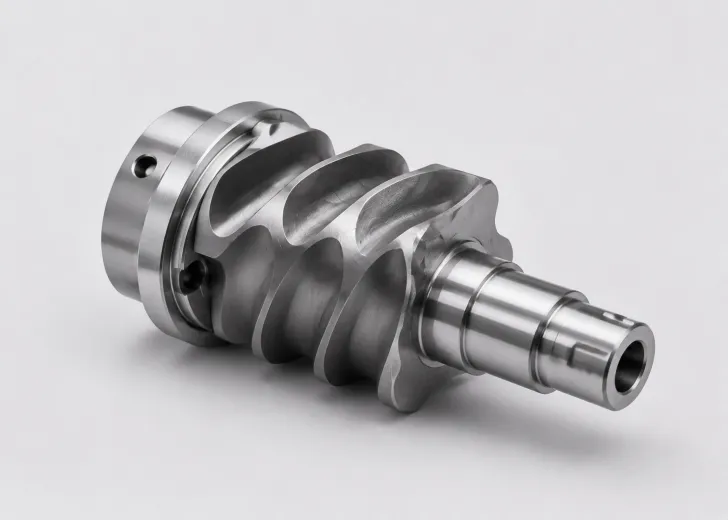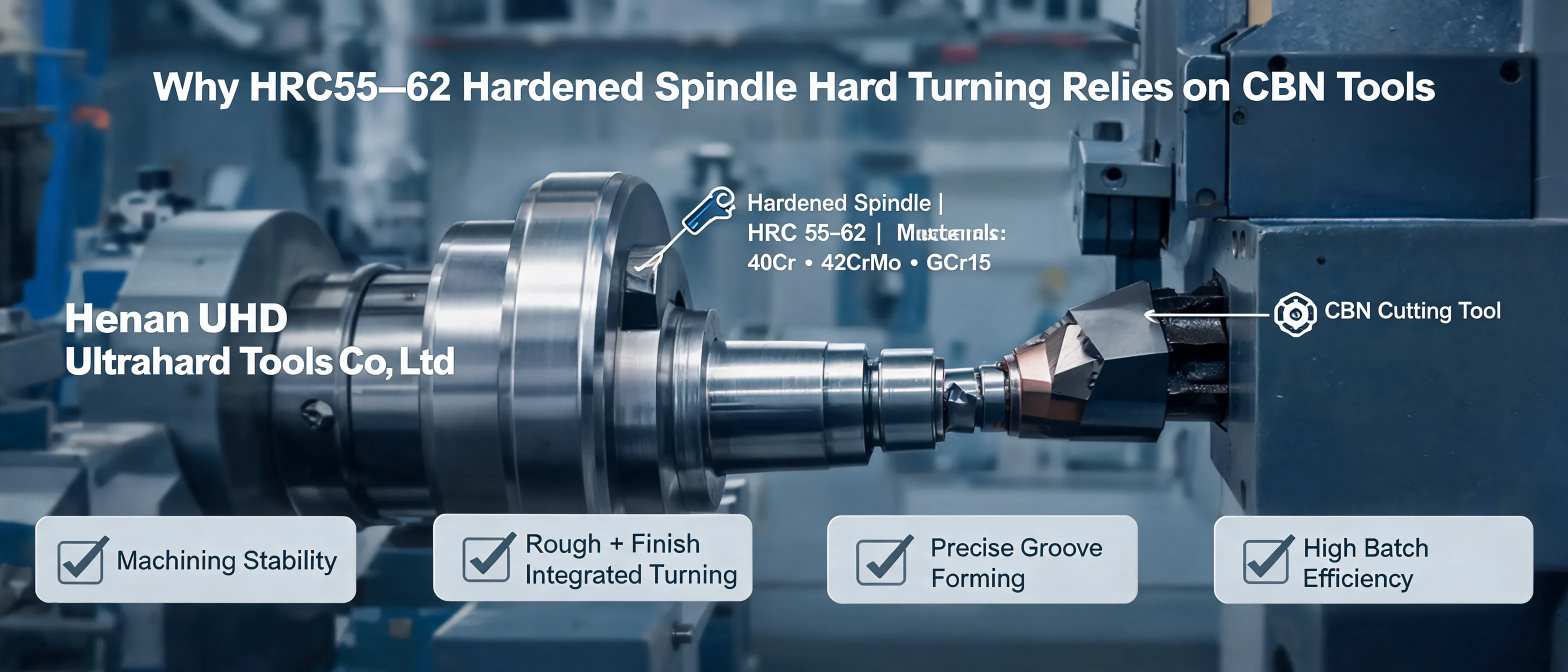
In hardened spindle hard turning, the move toward CBN tools is not simply a material preference. It is a practical response to the machining demands of 40Cr, 42CrMo, and GCr15 hardened to HRC55–62, where cutting stability, dimensional consistency, and batch efficiency must be balanced across different spindle features. For journals, flanges, seal seats, and groove sections, one universal insert often struggles to perform equally well in roughing, finish turning, and forming.
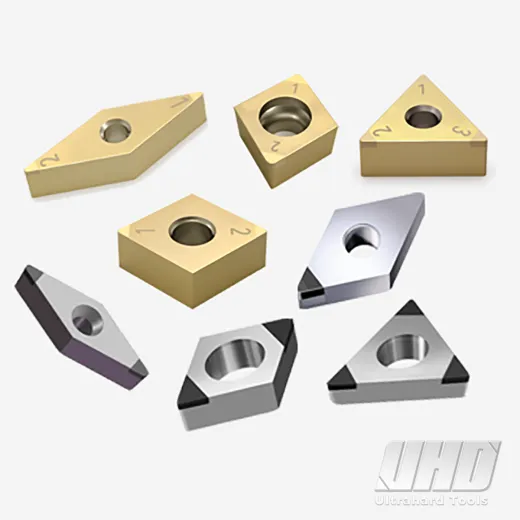
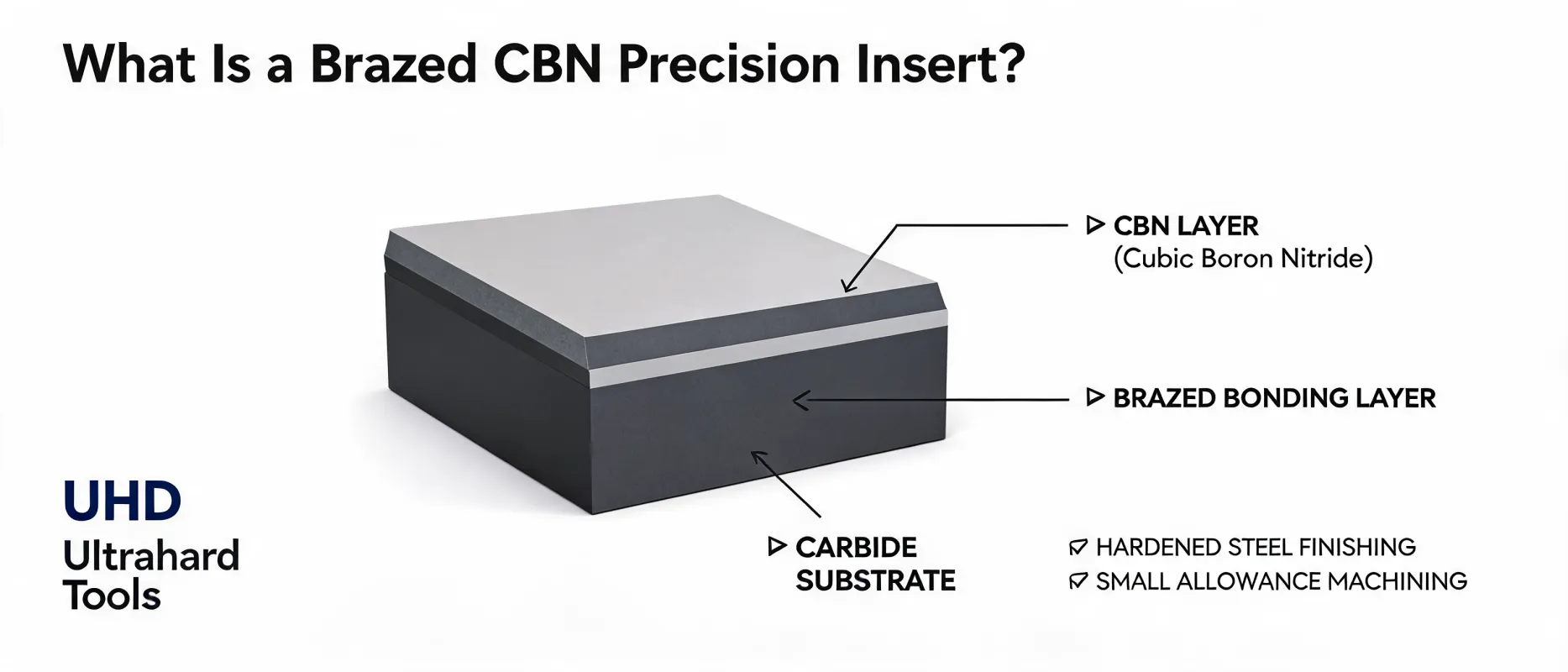
Henan UHD Ultrahard Tools Co., Ltd approaches this application with a process-based CBN setup: impact-resistant brazed CBN for roughing, coated CBN for stable dry finish turning, solid CBN for higher-precision sections, and CBN grooving inserts for withdrawal grooves and sealing grooves. This logic helps buyers and process engineers understand why CBN is increasingly the mainstream choice for hardened spindle hard turning rather than a niche option.
Machine tool spindles are not simple hardened shafts. They usually combine multiple functional sections on one part, and each section places different demands on the cutting edge:
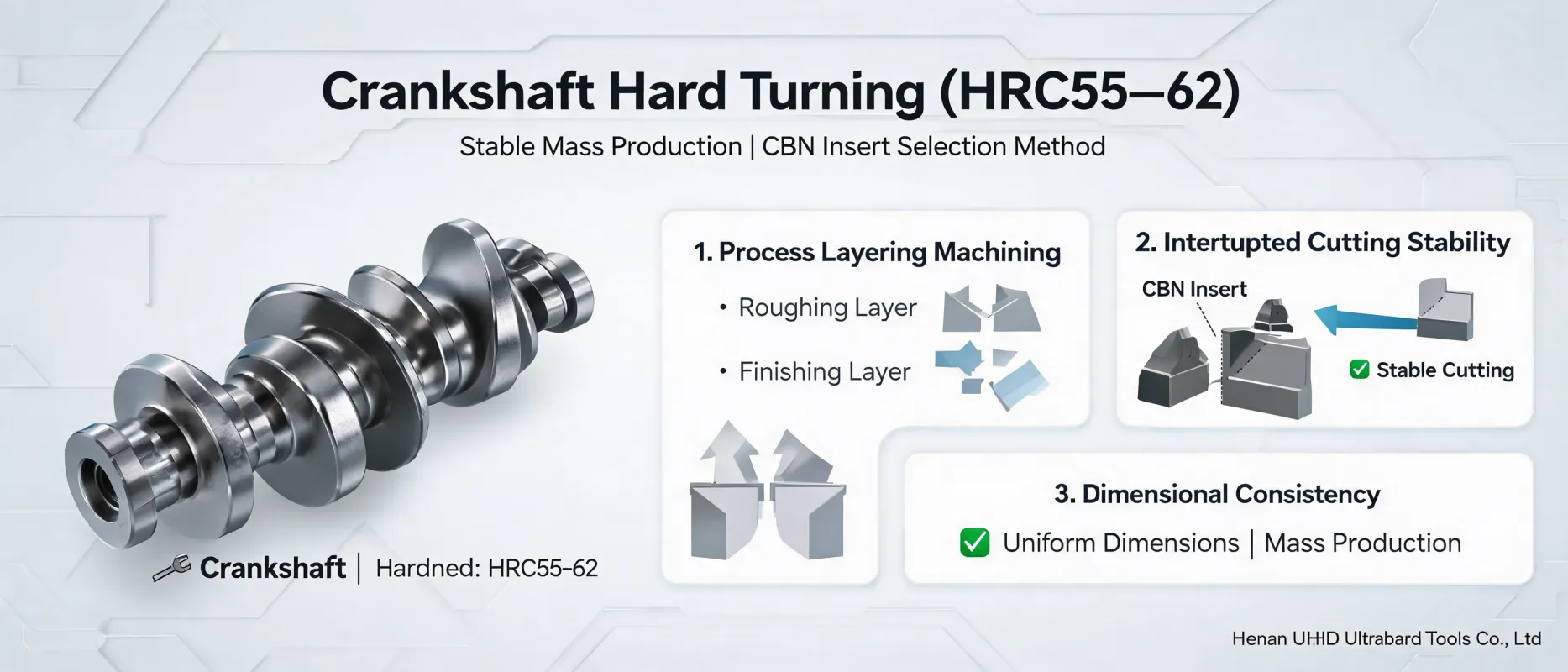
In the HRC55–62 range, these requirements become more difficult because hardened materials increase cutting resistance while step transitions, changing stock allowance, and interrupted contact can create impact loads. This is why hardened spindle hard turning increasingly relies on process-specific CBN tools instead of a single all-purpose insert.
Roughing spindle steps, radius transitions, or variable stock zones can cause impact loading. If the insert structure does not match the roughing condition, the cutting edge may chip early and tool life becomes difficult to predict.
When roughing is handled with a finish-oriented insert, material removal may remain conservative. The result is longer cycle time, more passes, and less efficient use of machine capacity in batch spindle production.
Journal and seal seat machining often requires repeatable dimensional control and stable finish quality. If insert wear changes unpredictably, production faces greater adjustment frequency and higher assembly risk.
Withdrawal grooves and sealing grooves are sensitive to vibration, built-up effects, and local edge damage. General-purpose turning inserts are often not the most stable option for these formed features.
The growing use of CBN inserts for hardened spindle machining comes from their ability to support a more rational division of labor in hard turning. Instead of asking one insert to do everything, CBN allows spindle machining to be organized by operation priority:
This process-based logic is one of the clearest reasons why CBN tool trend continues to strengthen in HRC55–62 machining. It aligns tool structure with the real cutting condition instead of forcing compromise across rough and finish integrated turning.
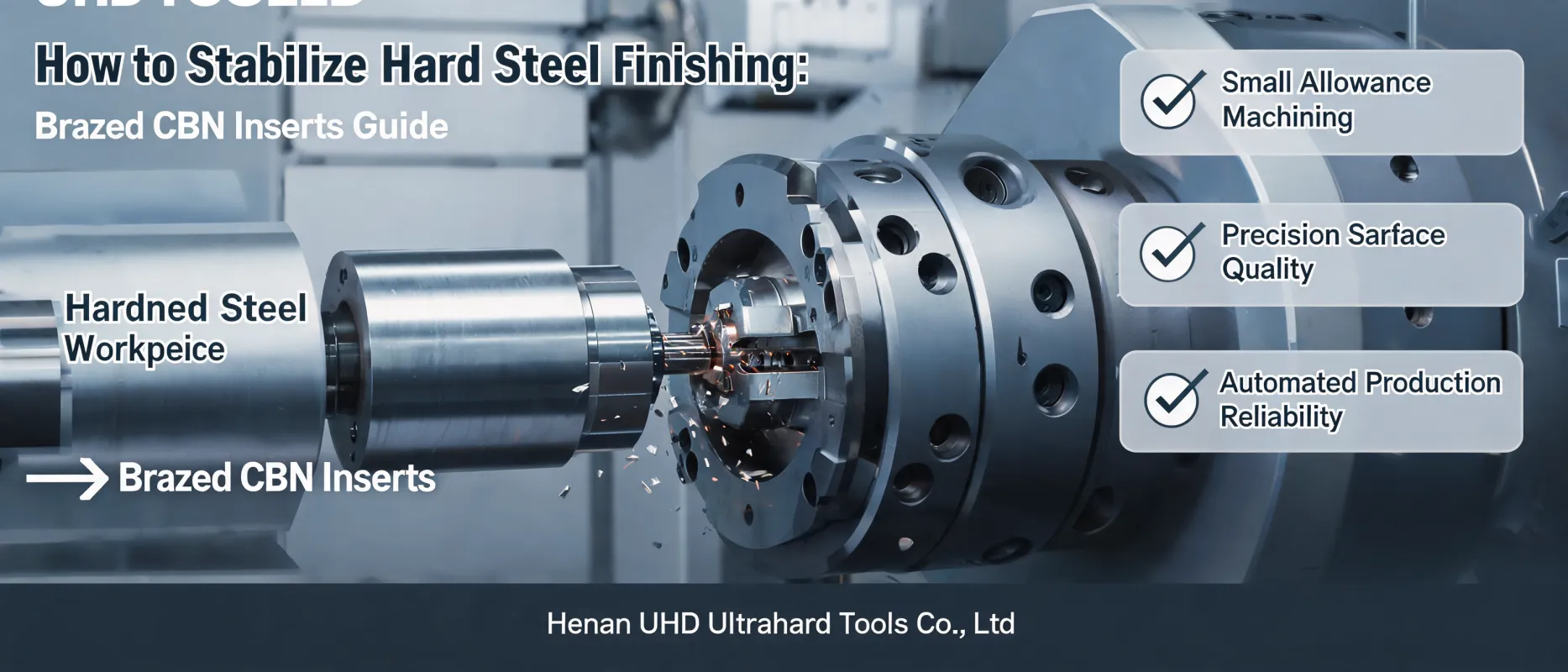
In hardened spindle roughing, the first challenge is often not ultimate finish quality but surviving interruption and removing stock efficiently. Brazed CBN is a practical option when the spindle has step changes, imperfect stock distribution, or working conditions that create intermittent impact.
Once stock has been controlled by roughing, the main requirement shifts to stable finish turning. For journals and oil seal positions, coated CBN is widely used because it supports more repeatable wear behavior and process control in dry hard turning conditions.
For high-end spindle journals where tighter geometric control and finer finish consistency are more sensitive, solid CBN provides an upgraded option. It is not necessary for every spindle application, but it becomes relevant when the process window is narrower and higher precision stability is required on key sections.
Groove features are often where a “one-insert-for-all” approach starts to break down. Withdrawal grooves and sealing grooves need stable bottom and side geometry, while also minimizing burrs and local tearing.
When hardened spindle roughing includes step shoulders or changing engagement, the key risk is unstable tool life. A brazed CBN roughing setup helps prioritize impact resistance and removal efficiency before finish quality becomes the main concern.
In repetitive production, coated CBN supports stable dry finish turning of journal diameters and oil seal positions, helping improve dimensional consistency and reduce adjustment frequency.
When process sensitivity is higher and finish stability becomes more critical, solid CBN can be selected for key spindle sections rather than applied broadly across the whole route.
Dedicated CBN grooving inserts are better suited when the groove profile must stay stable and burr formation must be controlled to avoid secondary finishing or scrap risk.
How can hard turning remain stable on HRC55–62 spindles without frequent chipping?
Stability generally improves when roughing and finishing are separated by tool function. Roughing should focus on impact resistance, while finish turning should focus on dimensional and surface control.
How can roughing efficiency and finish consistency be balanced in one spindle process route?
A rough-and-finish integrated turning strategy works better when each operation uses the CBN insert structure that matches its real machining task rather than relying on a single universal insert.
How can grooves be machined more consistently without burrs and rework?
Groove sections typically need dedicated CBN grooving inserts so the groove profile, edge condition, and cutting stability are handled as a forming task, not as a compromised turning task.
Matching insert structure to operation helps reduce sudden failure risk, especially in interrupted or variable-stock roughing conditions.
Predictability matters in production planning. Process-specific CBN selection helps make wear behavior easier to manage from roughing to finishing.
Journals, seal seats, and precision sections benefit when finish turning is assigned to inserts designed for stable dry hard turning rather than compromise cutting.
Better division between roughing, finishing, and groove forming can reduce avoidable stops, rework, and process variation in spindle production.
As a manufacturer focused on ultrahard cutting tools, Henan UHD Ultrahard Tools Co., Ltd supplies CBN insert solutions for hardened material turning, including CBN inserts, PCD/CBN formed tools, and non-standard customization. For spindle applications, this means the tooling route can be aligned with the actual combination of material, hardness, stock condition, spindle geometry, clamping condition, and production rhythm.
The practical value is not in promoting a single insert as universal. The value is in building a more suitable spindle machining route: brazed CBN for roughing under impact, coated CBN for stable finish turning, solid CBN for higher-precision sections, and dedicated CBN grooving inserts for formed groove features.
For manufacturers machining hardened spindles in HRC55–62, this is why CBN tools are increasingly becoming the mainstream choice: they support a clearer process structure, more controlled machining stability, and a more practical balance between productivity and precision across both batch and customized production environments.

Tell us your workpiece, quantity, and tooling requirement. Our team will reply with a practical solution.