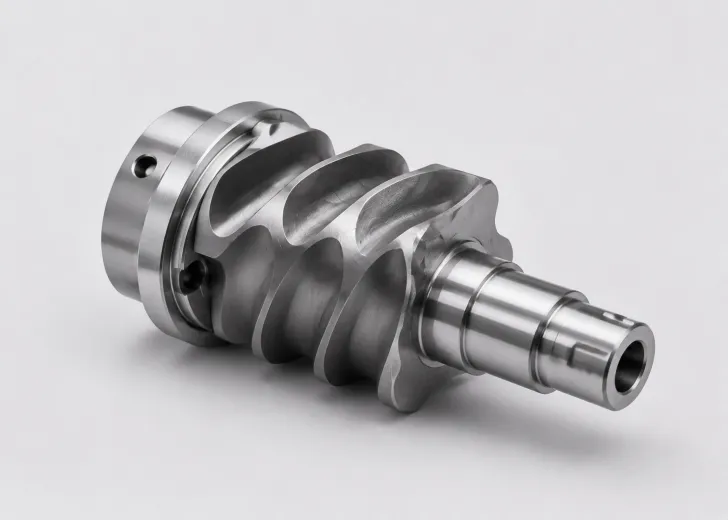
Hard turning quenched machine tool spindles made from 40Cr, 42CrMo, or GCr15 at HRC55–62 requires a tooling strategy that accounts for changing stock allowance, interrupted contact, dimensional requirements, and groove geometry. UHD provides a process-based CBN insert configuration for spindle journals, flanges, seal locations, relief grooves, and seal grooves.
Rather than applying one general-purpose insert to every operation, the solution separates heavy stock removal, stable finish turning, high-precision journal machining, and groove forming. This helps manufacturers select CBN tooling according to the actual cutting condition and production objective.
Machine tool spindles commonly include precision journals, stepped diameters, flanges, oil seal locations, relief grooves, and radiused transitions. At HRC55–62, these features can create different cutting loads within one workpiece. A tool that is suitable for finishing a journal may not provide the edge strength needed for interrupted roughing or groove machining.
Steps, flange transitions, varying allowance, and less-than-ideal workholding can generate impact loading that increases the risk of edge chipping during rough turning.
Journals and seal locations require controlled diameter, roundness, cylindricity, and surface finish across batch production.
Relief and seal grooves are sensitive to vibration, chip accumulation, edge damage, burrs, and inconsistent groove profiles.
Stable hardened spindle turning depends on matching the CBN grade and insert structure to the purpose of each operation. UHD applies a roughing–finishing–precision–grooving approach so that impact resistance, cutting stability, surface control, and form accuracy can be addressed separately.
| Operation Module | Recommended UHD CBN Insert | Typical Spindle Areas | Primary Focus |
|---|---|---|---|
| Heavy roughing | Integral brazed CBN insert | Rough journals, flanges, radiused transitions | Impact resistance and efficient stock removal under interrupted or variable cutting conditions |
| Batch finish turning | Coated CBN insert | Journals and oil seal locations | Stable dry high-speed finishing, dimensional control, and surface consistency |
| High-precision finishing | Solid CBN insert | High-precision spindle journals | Enhanced process stability for demanding surface and geometric requirements |
| Grooving and forming | CBN grooving insert | Relief grooves and seal grooves | Controlled groove profile, reduced risk of tearing, burrs, and edge chipping |
For bearing and mating journals, coated CBN inserts support stable dry finish turning in production environments. Where the application has more demanding precision requirements, solid CBN inserts can be considered for the critical journal operation.
Brazed CBN inserts are intended for roughing areas where changing engagement and heavy removal place greater demands on edge toughness and impact resistance.
The finish-turning module focuses on consistent size and surface control for seal contact areas, helping support reliable downstream assembly conditions.
Dedicated CBN grooving inserts provide a purpose-built option for formed groove operations, where groove sidewalls, bottoms, and transitions need controlled machining behavior.
CBN insert selection should be based on the real machining condition rather than material hardness alone. For hardened machine tool spindle turning, UHD can evaluate the following inputs when defining a standard or non-standard solution:
The roughing operation should prioritize an impact-resistant CBN insert structure and a cutting edge prepared for the actual load. Integral brazed CBN inserts are used in this solution for heavy roughing, stepped sections, and conditions with variable allowance or interrupted engagement.
Roughing and finishing have different priorities. Roughing requires stronger resistance to impact and stock-removal loads, while finishing requires controlled geometry, stable dimensions, and consistent surface quality. Separating these tasks reduces the compromises of a one-insert approach.
Coated CBN inserts are the primary option in this configuration for dry high-speed finish turning of journals and seal locations. Solid CBN inserts can be selected for critical journal operations with more stringent precision and surface consistency requirements.
A dedicated CBN grooving insert is recommended for hardened groove forming. Compared with using a general turning insert for the task, a purpose-designed grooving solution is better aligned with the requirements of groove width, profile control, and edge stability.
Henan UHD Ultrahard Tools Co., Ltd. develops and supplies CBN inserts for hardened steel turning, including brazed CBN, coated CBN, solid CBN, and CBN grooving insert configurations. For machine tool spindle applications, UHD can support tool selection and customized solutions based on part geometry, cutting condition, machine setup, and production requirements.
The objective is a practical tool configuration for roughing, finishing, and formed features—not a one-size-fits-all claim—so manufacturers can build a more controlled hard-turning process for quenched 40Cr, 42CrMo, and GCr15 spindles.


Tell us your workpiece, quantity, and tooling requirement. Our team will reply with a practical solution.