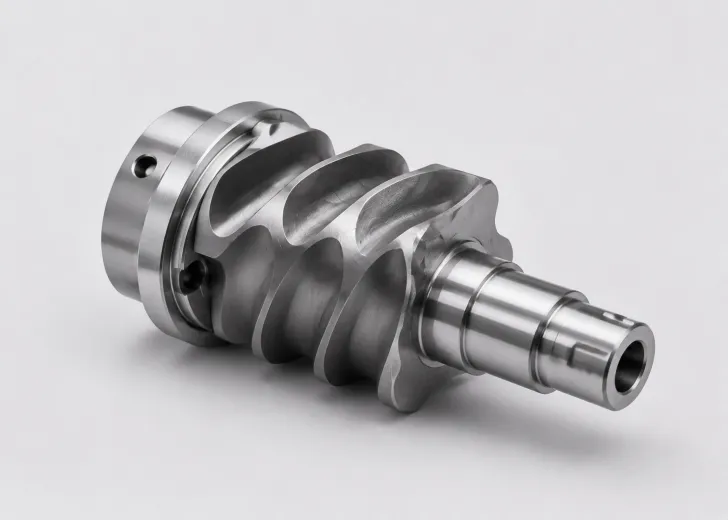
Chilled cast iron in the HRC50-65 range places different demands on roughing and finishing operations. Hard, brittle surface layers, variable casting conditions, and interrupted profiles can increase the risk of edge chipping during heavy cuts. In finishing, the priority shifts to predictable wear, stable dimensions, and consistent surface quality across production batches.
UHD, the brand of Henan UHD Ultrahard Tools Co., Ltd, applies a process-specific CBN insert approach: USN100 integral brazed CBN inserts for impact-resistant heavy roughing, and BN91 full-face CBN inserts for continuous or light-interrupted semi-finishing and finishing.
Chilled cast iron is commonly machined in metallurgical rolls, camshafts, slurry pump housings, liners, crushing components, and other wear parts. Depending on the component and casting condition, machining may involve hard skin variation, porosity, sand inclusions, interrupted contours, or local impact loads.
Large allowances and severe interrupted cuts can cause chipping, corner breakage, or insert damage. The first requirement is a cutting edge that can better tolerate impact and unstable stock conditions.
Continuous or light-interrupted cuts require controlled wear behavior. Tool life variation can lead to surface inconsistency, dimensional drift, unplanned tool changes, and rework.
For this reason, one insert should not be expected to cover both severe interrupted roughing and high-consistency finishing. Separating the process by operation and interruption intensity creates a clearer basis for tool selection and parameter control.
| Machining condition | Recommended UHD insert | Starting parameter window | Selection focus |
|---|---|---|---|
| Heavy roughing with severe interruption Rolls, pump housings, liners, and parts with hard skin variation, defects, or unstable stock. |
UHD USN100 Integral brazed CBN insert series |
Vc: 50-100 m/min f: 0.15-0.40 mm/rev ap: 0.5-3.0 mm |
Impact resistance and reduced risk of chipping or edge breakage under heavy interrupted loading. |
| Semi-finishing and finishing with continuous or light interruption Roll finishing, camshaft machining, impellers, and wear components requiring stable output. |
UHD BN91 Full-face CBN insert series |
Vc: 80-150 m/min f: 0.08-0.20 mm/rev ap: 0.2-0.8 mm |
Wear consistency, surface stability, and dimensional control in batch finishing operations. |
The values above are general starting windows for HRC50-65 chilled cast iron. Final settings should be adjusted according to machine rigidity, workholding, allowance consistency, interrupted-cut severity, and chilled-layer uniformity.
The UHD USN100 integral brazed CBN insert series is intended for roughing operations where impact is the dominant risk. This includes heavy stock removal on chilled rolls, cast wear parts, and components where hard skin inconsistency or casting-related defects may repeatedly load the cutting edge.
When chipping persists, the first response should be to reduce the source of impact: review depth of cut, feed transitions, toolpath entry, overhang, and clamping stability. Cutting speed can then be adjusted after the mechanical load is under control.
The UHD BN91 full-face CBN insert series is suited to continuous or light-interrupted cuts where the objective is not simply to remove material, but to maintain repeatable tool life, surface quality, and dimensional consistency. Its full-face CBN structure supports finishing applications that may contribute to a turning-for-grinding process route when the full machining system is stable.
For BN91 finishing, allowance variation and machine vibration should be addressed before increasing cutting speed. Maintaining a stable stock condition and avoiding unnecessary dwell or re-entry helps reduce fluctuations in wear and finished surface quality.
For a workpiece that combines interrupted rough turning with continuous finishing, use a split process: USN100 for roughing and BN91 for finishing. This approach avoids exposing a finishing-oriented insert to unnecessary impact while allowing the final operation to focus on repeatability.
Confirm material grade, HRC range, chilled-layer depth and uniformity, stock allowance, machine setup, clamping, component overhang, and current insert failure mode.
Begin USN100 in the lower-to-middle speed range for roughing, or BN91 near the middle speed range for finishing. Check edge condition, finish, dimensions, and chip evacuation.
For roughing chipping, first reduce impact and improve rigidity. For finishing variation, first stabilize allowance and cutting load before refining speed and feed.
Document insert grade, holder and clamping method, approved parameter window, wear limit, tool-change rule, and exception criteria for repeatable production.
USN100 is selected for impact-resistant roughing and should not automatically be treated as the preferred option for the final high-quality finishing pass. BN91 is intended for continuous or light-interrupted semi-finishing and finishing; it is not recommended as the default choice for severe interrupted cuts with large, unstable allowances.
For remote project evaluation, UHD can work from application information including workpiece drawings, material hardness, machining stage, machine and holder details, existing cutting parameters, and photographs of insert wear. This structured feedback enables clearer selection between USN100 and BN91 and supports the development of a repeatable process for chilled cast iron rolls, camshafts, pump housings, and wear parts.
Tell us your workpiece, quantity, and tooling requirement. Our team will reply with a practical solution.