


Interrupted Cutting and Impact
The changing cam profile creates periodic cutting impact. Excessive impact loading can lead to edge chipping, insert breakage and unplanned tool changes.

UHD provides a staged CBN tooling solution for machining chilled cast iron and carburized hardened steel camshafts in automotive production. By coordinating rough, semi-finish, finish turning and grooving with matched CBN insert structures, the solution addresses interrupted cutting, edge chipping, profile accuracy and surface consistency.
UHD Camshaft Machining Solution
Henan UHD Ultrahard Tools Co., Ltd. provides a staged CBN tooling solution for machining chilled cast iron and carburized hardened steel camshafts at HRC58–64. The solution coordinates rough turning, semi-finishing, finishing and grooving with matched CBN insert structures to improve cutting stability, camshaft profile accuracy and surface consistency.
Solution summary: Instead of applying one insert type across the complete process, UHD assigns different CBN insert structures to the camshaft profile, journals and relief grooves according to the cutting load and process objective of each operation.
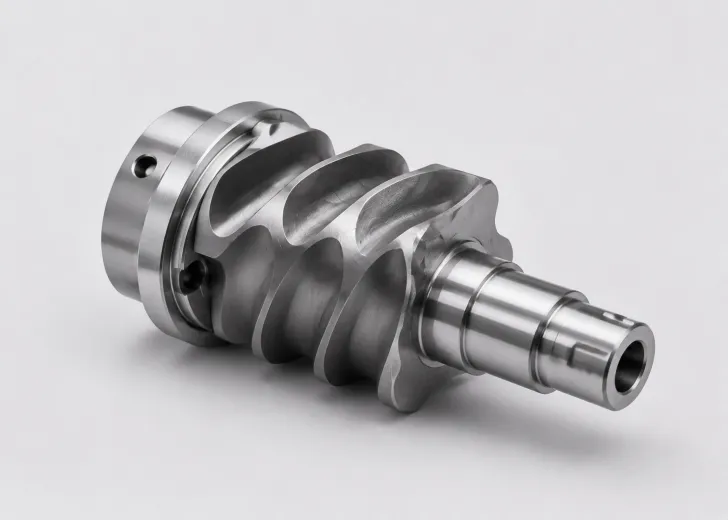
Camshafts made from chilled cast iron or carburized hardened steel commonly require precision machining at a hardness range of HRC58–64. The process may include cam lobe profiles, journals and relief grooves, each with different cutting forces, heat conditions and dimensional requirements.
The changing cam profile creates periodic cutting impact. Excessive impact loading can lead to edge chipping, insert breakage and unplanned tool changes.
Camshaft profile accuracy directly affects valve-train or transmission performance. Tool wear and cutting instability can cause profile error and dimensional drift.
Finishing operations must maintain consistent surface quality while controlling wear under high-hardness cutting conditions.
Grooving concentrates cutting forces at a small edge area, increasing the risk of chipping, built-up material and groove-width or groove-depth variation.
The central process question is: how can stable cutting efficiency be maintained when high hardness and interrupted cutting occur together?
A single CBN insert type rarely provides the best balance between impact resistance during roughing and wear resistance during high-precision finishing. UHD therefore uses a “part location × operation” configuration. Roughing prioritizes toughness and edge security; semi-finishing stabilizes the remaining allowance; finishing prioritizes wear control and profile consistency; grooving uses a dedicated geometry for localized cutting loads.
The following allocation separates conflicting process objectives and creates a more controllable machining sequence for camshaft production.
| Machining stage | Main area | Recommended CBN insert | Primary objective |
|---|---|---|---|
| Rough turning | Cam lobe profile | Integral Brazed CBN Insert | Manage interrupted cutting, improve edge security and support stable material removal. |
| Semi-finishing | Journals and cam side faces | Composite Brazed CBN Insert, uncoated | Balance dimensional stability, form control and reliable wear before finishing. |
| Finish turning | Cam lobe profile | Coated CBN Insert | Support wear resistance, profile accuracy and consistent surface quality at higher cutting speeds. |
| Ultra-finishing | High-precision cam profile | Solid CBN Insert | Provide a higher process ceiling where profile error, surface integrity or consistency requirements are more demanding. |
| Grooving | Journal relief grooves | CBN Grooving Insert | Control concentrated cutting loads and help stabilize groove width, depth and edge quality. |
Integral brazed CBN inserts are assigned to rough turning where cam lobe variation creates substantial interrupted cutting. The priority is to reduce edge chipping and abnormal breakage while maintaining a stable removal process and a predictable allowance for later operations.
Uncoated composite brazed CBN inserts are used for semi-finishing journals and cam side faces. This stage focuses on controlling dimensional and form variation so that the finishing operation receives a consistent machining allowance.
Coated CBN inserts are selected for high-speed finishing of the cam profile. Their role is to support a more stable wear pattern, helping control profile accuracy and surface consistency during the finishing stage.
Solid CBN inserts can be introduced when the camshaft requires a higher level of profile control, surface integrity or repeatability than the standard finishing process can provide.
Dedicated CBN grooving inserts are used for journal relief grooves. The specialized insert configuration addresses concentrated edge loading and supports more consistent groove dimensions and edge condition.
UHD defines the tooling configuration by combining material hardness, machining location, operation sequence and cutting continuity. This avoids selecting inserts only by material grade and instead evaluates the complete cutting condition.
Typical issue: pronounced interrupted cutting, frequent edge chipping, unstable cycle time and elevated insert consumption during roughing.
Configuration logic: use integral brazed CBN for roughing, then separate semi-finishing and finishing so that coated CBN can provide more stable finishing performance.
Typical issue: profile accuracy and surface consistency are difficult to maintain as tool wear progresses under HRC58–64 cutting conditions.
Configuration logic: use composite brazed CBN for stable semi-finishing allowance, coated CBN for finishing, and solid CBN where ultra-finishing requirements are higher.
Typical issue: one production line processes profiles, journals and grooves with different force and accuracy requirements.
Configuration logic: configure tooling by feature and operation rather than using one insert across the complete line. Dedicated grooving inserts are used for relief grooves.
The second process question is: how can a customized tooling configuration improve machining accuracy while reducing total operating cost? The answer is to coordinate insert design, process parameters and service support around the actual machine and workpiece conditions.
Henan UHD Ultrahard Tools Co., Ltd. is a China-based manufacturer and B2B supplier of superhard cutting tools for precision metal cutting. Established in 2018 in Zhengzhou High-tech Zone, Henan, UHD focuses on CBN and PCD tooling, non-standard tool customization and application-oriented technical support.
Tell us your workpiece, quantity, and tooling requirement. Our team will reply with a practical solution.