



Stable Semi-Finishing and Finishing of WC-Co Carbide Rolls and Mold Cores with Solid CBN Inserts
UHD Tools provides solid CBN inserts for stable semi-finishing and finishing of WC-Co carbide rolls and mold cores at HRA 85–92. The solution supports controlled micro-cutting, reduced edge-chipping risk, more predictable tool life, and a repeatable selection-to-validation process for batch production.
WC-Co carbide rolls and mold cores at HRA 85–92 require more than cutting capability: semi-finishing and finishing operations must keep surface condition, dimensional consistency, and tool life under control. Small depth-of-cut and feed conditions can amplify the effect of edge damage, while local hardness variation, shoulders, or light interrupted cuts may trigger unpredictable chipping.
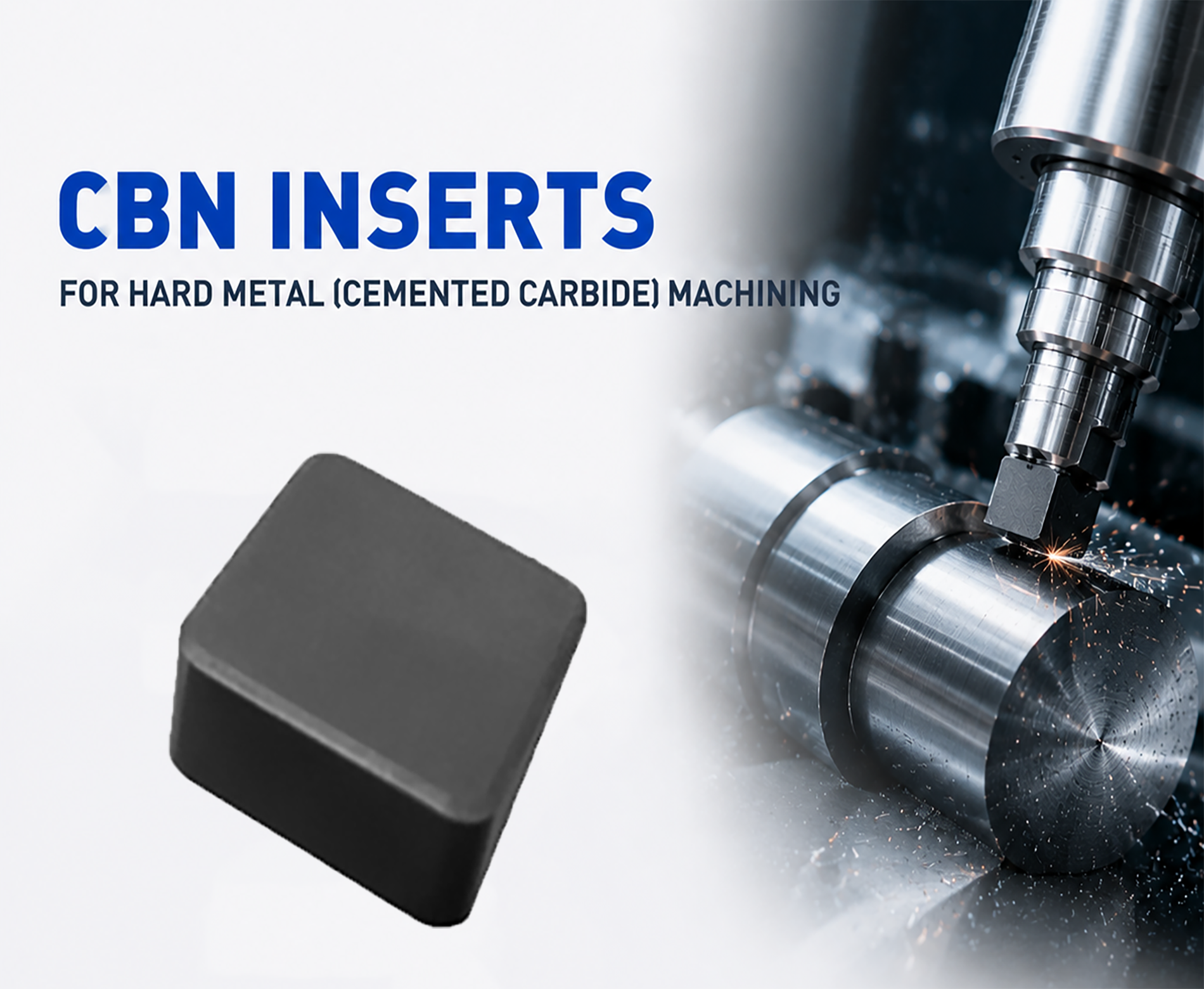
For these conditions, UHD Tools Solid CBN Insert Series supports a more stable turning process. Its homogeneous solid structure has no brazed interface, helping reduce interface-related failure paths and making tool wear behavior easier to observe and manage. The objective is to establish a practical, repeatable parameter window for batch production rather than rely on one-time trial results.
CBN Insert Selection Reference for WC-Co Carbide
| Material Hardness | Typical Workpiece | Machining Condition | Recommended Insert Series + Grade | Cutting Speed Vc (m/min) | Feed f (mm/r) | Depth of Cut ap (mm) |
|---|---|---|---|---|---|---|
| Cemented Carbide (WC-Co YG6/8, HRA85-92) | Carbide rolls, mold cores | Finishing, semi-finishing, micro-cutting | Solid CBN Insert Series → UBN S4 | 20-60 | 0.02-0.10 | 0.05-0.20 |
The above values are a starting reference. Final parameters should be confirmed through on-machine validation according to workpiece condition, rigidity, and required finish.
A Controlled Route from Selection to Batch Production
- Define the operating condition: confirm WC-Co grade or cobalt range where available, hardness, stock allowance, surface target, cutting continuity, machine rigidity, and clamping condition.
- Validate a stable window: assess early edge chipping, tool-life variation, surface trend, and dimensional drift through small-batch trial cutting—not only whether the insert can remove material.
- Standardize production control: record approved speed, feed, depth of cut, edge preparation, and replacement criteria in a process sheet. This helps move tool changes into a predictable interval before sudden failure affects the workpiece.
Implementation Priorities and Applicable Boundaries
- Keep tool overhang short and workpiece runout controlled; vibration can cause micro-chipping even with an appropriate CBN grade.
- Pay particular attention to shoulders, chamfers, and transitions where light interruption or impact occurs.
- For special geometries, restricted access, or dedicated edge requirements, non-standard insert configuration should follow a sample validation, small-batch, then production introduction path.
- This solution is intended for high-hardness WC-Co carbide turning. It should not be generalized to aluminum, copper, or austenitic stainless-steel machining.
For technical coordination: provide workpiece hardness and material information, machining allowance, current insert and parameters, machine and clamping details, cooling method, and photos or descriptions of wear patterns. These inputs allow UHD Tools to support a clearer selection and verification process for stable WC-Co carbide turning.
Recommended Products
Get Technical Solution
Tell us your workpiece, quantity, and tooling requirement. Our team will reply with a practical solution.